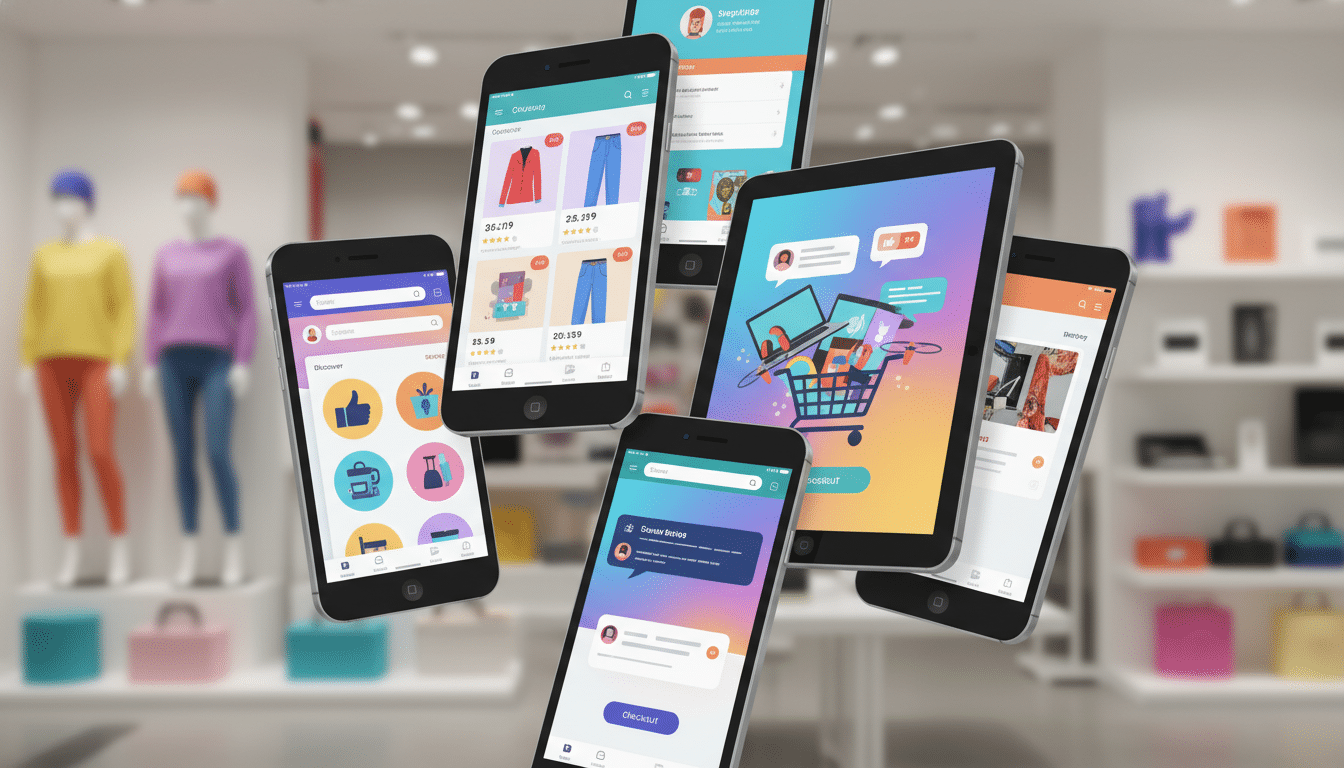
Many shoppers open an app and stay because it fits their daily routine. User engagement shows through browsing, saving items, or adding to cart. It also appears when they purchase or share products.
These actions reveal ecommerce behavior. They help explain why app usage varies by person and by situation.
Anúncios
For brands, higher engagement leads to better conversion rates and larger average order values (AOV). It also improves lifetime value (LTV). Apps like ASOS, Zara, and Sephora use personalized feeds, fast checkout, and social features to boost retention and sales.
This article breaks down why people return to shopping apps. It covers measurable metrics, personalization, checkout, performance, and trust elements like reviews. You will find clear examples and practical steps to improve your own app.
Key Takeaways
- User engagement includes all in-app actions that reflect intent and loyalty.
- Ecommerce behavior shapes how often and how deeply people use an app.
- Improved app usage tends to raise conversion rates, AOV, and LTV.
- High-engagement brands like ASOS, Zara, and Sephora focus on personalization and speed.
- The article will examine metrics, personalization, checkout, performance, and trust.
User engagement
User engagement in shopping apps measures how people interact with products and the brand. It covers active behaviors like searching, filtering, adding to favorites, and starting checkout. It also includes passive signals such as time on page and scrolling.
Defining user engagement in shopping apps
Quality matters more than raw numbers. Meaningful actions show purchase intent or brand affinity. Event tracking, funnel analysis, and cohort segmentation help find real intent.
Key engagement metrics: retention, session length, frequency
Track retention by cohort: day 1, day 7, and day 30. These rates show if the app keeps offering value. Measure session length to see if users dive deep or get stuck by friction.
Count frequency to learn how often users open the app in a week or month.
- Retention metrics: compare cohorts before and after feature launches.
- Session length: longer can mean discovery or frustration; check conversion and bounce rates.
- Frequency: boost with fresh content, useful notifications, and timely offers.
Related figures like conversion rate, average order value, and churn show how engagement links to revenue. Use cohorts to test if a change improved app usage and ecommerce behavior over time.
How engagement differs between mobile web and native apps
Native apps offer faster load times, better personalization, and offline features. These raise average user engagement and improve wishlist and saved-card features.
Mobile web removes the install barrier and helps with quick lookups. It often shows lower session depth and fewer saved preferences than apps. People choose native apps more for deep browsing and repeated interactions.
- Use web visits to promote clear app benefits like saved cards and exclusive offers.
- Move core features to app-only when it genuinely improves performance and app usage.
- Test differences in ecommerce behavior by measuring cohorts across platforms.
Personalization and relevant recommendations
Personalization grabs attention and turns casual browsing into frequent app use. Clear suggestions help users find items faster. This boosts engagement without overwhelming shoppers.
Behavioral data and tailored product suggestions
Clickstreams, search queries, past purchases, and time spent on items feed recommender systems.
These signals help show items users are likely to add to their carts.
Common methods include collaborative filtering, content-based models, and hybrid systems that combine both.
Each method has pros and cons for new users and scaling.
- Tested patterns like “recommended for you” carousels and “complete the look” suggestions raise add-to-cart rates.
- Better relevance cuts discovery time and improves ecommerce behavior.
Dynamic home screens and personalized offers
Home feeds adapt to styles, sizes, and price sensitivity. This keeps content fresh and invites repeat visits.
Personalized push messages and in-app banners for curated drops or restocks can increase usage frequency.
- Prioritize relevance over volume to avoid message fatigue.
- Limit push notifications to clear events, like restocks or size matches.
- Use visible benefits in the feed to encourage continued app use.
Balancing privacy with personalization to retain trust
Transparency about data use and simple privacy controls build user trust.
Allow users to opt out or limit tracking without losing key benefits from recommendations.
- Offer a preference center where people select styles and sizes, reducing passive data needs.
- Explain trade-offs: richer personalization needs behavioral data but must show real value.
- Use lightweight signals like saved favorites or explicit likes to improve suggestions.
Short, practical steps help request preferences and show value:
- Ask one question at sign-up about preferred styles or sizes.
- Show a clear toggle for personalized offers in account settings.
- Provide examples of benefits, like faster discovery or curated drops, so users see why to share signals.
Seamless checkout and payment options
Checkout is the last step where small problems cause lost sales. Smart checkout optimization cuts steps and keeps users engaged across the app. Clear and short flows match modern ecommerce habits and boost app use.
One-click checkout and saved payment methods
Saving cards and offering one-tap purchase shortens the path from intent to buying. Tokenization and biometric checks protect stored payment data while keeping flow fast. Integrations like Apple Pay and Google Pay speed decisions for mobile shoppers by removing form-filling.
Support for diverse payment options
Shoppers expect wallets, cards, and buy-now-pay-later choices. BNPL often boosts average order value when shown clearly. Show the total cost and simple payment plan so customers know their commitment. Test which payment options convert best and show the most-used methods first.
Reducing friction with guest checkout and progressive profiling
Guest checkout captures first-time buyers who don’t want an account. After purchase, progressive profiling asks for one detail at a time—email, size, preferences. This builds a better profile without scaring users away. Use CTAs like save payment for faster checkout rather than forcing signup right away.
- Do shorten forms and prefill where possible.
- Do display fees and delivery costs early in the flow.
- Don’t hide charges until the last step.
- Don’t force full registration before purchase.
In-app experience and performance
Fast, friendly apps keep shoppers browsing. Good app performance shapes user engagement and usage patterns. Small design choices impact ecommerce behavior widely.
Fast load times and offline resiliency
Aim for sub-second key-screen loads and quick time-to-interactive to reduce drop-off. Use lazy loading for images, CDN delivery, and optimized asset sizes.
This approach ensures fashion photography looks great without slowing pages.
Cache catalogs and save carts for offline resiliency. This lets users browse and purchase when connectivity is spotty. It also keeps session length healthy.
Intuitive navigation and accessible UI
Make categories clear and keep search persistent. Visible cart icons, simple filters, and large tappable targets reduce friction.
These features increase repeat app usage. Design mobile-first with legible fonts and good color contrast. Add alt text and voice-over friendliness to widen reach.
Using animations and microinteractions to increase delight
Use short, purposeful animations for add-to-cart confirmations and progress bars. They reward actions without delaying flows.
Microcopy like Check delivery and Try on virtually guides users and reduces hesitation. Balance rich visuals with snappy performance.
Imagery should impress without harming app performance or user engagement.
Quick checklist for dev and design teams:
- Measure key-screen loads and set sub-second targets.
- Implement lazy loading and CDN for images.
- Cache catalogs and persist carts for offline use.
- Optimize tappable areas and font sizes for mobile UX.
- Keep animations under 200 ms and purposeful.
Trust, reviews, and social proof
Shopping apps build trust by showing clear social proof. They make app usage feel safe and easy. Short, scannable review blocks help users engage more with ecommerce sites.
Visible return details also encourage better user behavior and higher engagement.
Displaying real customer reviews and ratings
Show star scores, recent short quotes, and photos to reduce purchase worries. Add verified-purchase badges and filters for size, fit, and sentiment. Keep reviews short so readers can scan and decide quickly.
Integration of social features and user-generated content
Feature customer photos and short videos from uploads or Instagram-style galleries. This builds authenticity. Use “most-bought” tags, trending lists, and “people like you bought” nudges to influence shopping gently.
Clear return policies and transparent shipping information
Show return windows, return payment details, and refund timelines on product pages and checkout. Use plain language and FAQs to lower support requests. This helps increase buyer confidence.
Practical guidelines to present trust signals effectively:
- Display verified badges and recent reviews at the top of the product card.
- Include photos and short pros/cons tags for each review.
- Make return and shipping terms visible before checkout.
- Reward reviewers with loyalty points to boost contributions.
- Use simple filters for size and fit feedback to cut decision time.
When trust signals are clear and simple, user engagement grows. App users often convert faster when trust features are visible.
Loyalty programs and gamification
Smart loyalty programs turn casual shoppers into regulars by blending clear rewards with playful mechanics. This mix lifts user engagement and nudges app usage. It shapes measurable changes in ecommerce behavior.
Designing rewards that drive repeat purchases
Keep rewards simple and relevant. A small discount, early access to new drops, or free returns feels valuable to fashion shoppers. Tiered benefits work well when each level adds obvious perks like styling sessions or free alterations.
Test one reward at a time to avoid confusion.
Gamification mechanics: badges, progress bars, challenges
Progress bars show how close a user is to the next reward. This boosts frequency of visits. Badges and collectible markers create a sense of achievement without being intrusive.
Limited-time challenges, such as leaving a review to earn points, drive short-term spikes in engagement.
Measuring program effectiveness and lifetime value uplift
Track repeat purchase rate, average order frequency, churn, and incremental lifetime value to see real impact. Run A/B tests comparing core app usage to versions with loyalty features. Link results to revenue and retention goals so teams can justify budget and iterate.
- Weekly: active members, points issued, redemptions.
- Biweekly: repeat purchase rate, session frequency.
- Monthly: churn, average order value, LTV lift.
Conclusion
This piece shows the main drivers that keep users in shopping apps: clear engagement metrics, smart personalization, frictionless checkout, fast performance, visible trust signals, and simple loyalty mechanics.
Teams that track retention and session patterns gain better insight into ecommerce behavior and app usage.
Actionable next steps are practical: measure cohorts, prioritize checkout and performance wins, add clear preference settings, and test one loyalty mechanic at a time.
Small experiments on user engagement often reveal bigger lifts than a single flashy feature.
Remember that results vary by audience and product mix, so avoid promises of guaranteed outcomes.
Try one change, measure its effect on shopping apps retention and ecommerce behavior, then iterate based on real app usage data.
Content created with the help of Artificial Intelligence.